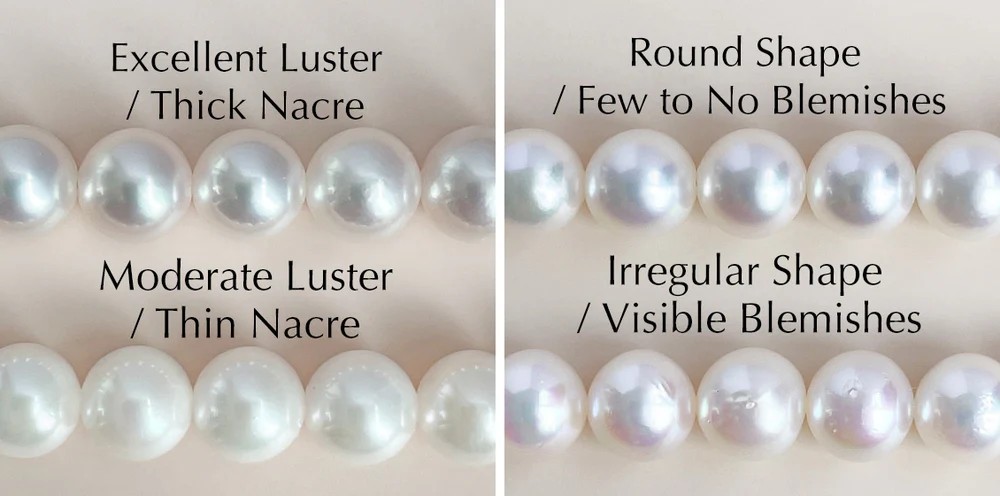
Luster: Luster makes or breaks pearls as a gemstone, and this should be your #1 buying priority. It is easily the MOST important value factor of all to consider when considering how to shop for pearls. Luster describes the way light reflects off the pearl surface; it can be sharp and highly reflective or soft and blurry (and no one wants a chalky bead!). The sharper the luster, the more valuable the pearl. *According to the Gemological Institute of America (GIA), pearl luster is the most important value factor, followed by surface quality, shape, color, and size. [GIA Pearl Value Factors]
Shape:Truly round pearls are the rarest shape of all, and the most valued. After that, we look for symmetrical semi-baroque shapes like tear-drops and ovals, then circled baroques and finally, free form baroques which are totally asymmetrical.
Surface Quality: Obviously, pearls with smooth, clean surfaces are more highly valued than those with multiple inclusions, so aim for buying the pearls with the cleanest surface you can. Try to avoid pearls with multiple deep inclusions, gouges in the nacre, and anything that shows the bead nucleus inside.
Size: large, perfectly symmetrical pearls are RARE, taking many years to form inside the oyster. If all other value factors are equal, the larger pearls will be the more valuable ones. We do recommend stepping down in size in order to get the luster and surface quality you really want. Highly lustrous, clean pearls are more valuable than large pearls with chalky, blemished surfaces.
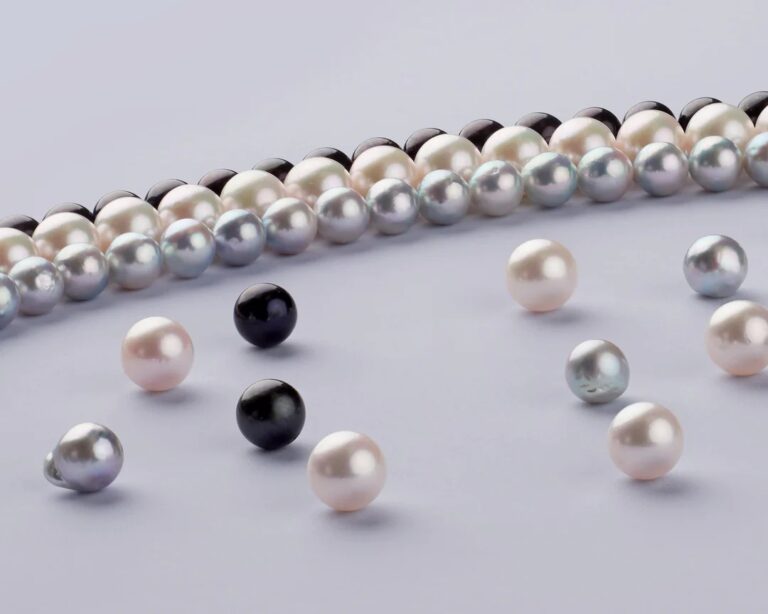
Color:Pearls come in every color of the rainbow. This value factor is weighted according to whether the color is naturally-occurring, the depth and saturation of the color, and the rarity of the color. Natural white and black pearl colors are the most valued, followed by gold, then pink, lavender and peach.